

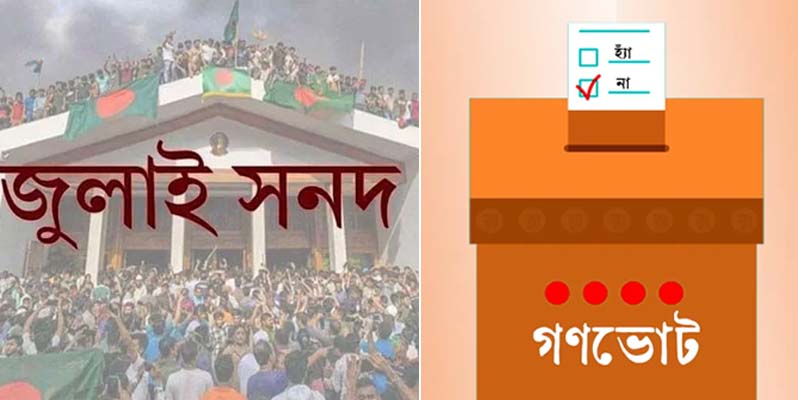
Muktadesh Desk: The one-week deadline given by the government to political parties to decide on the implementation of the July Charter and the referendum ended on Sunday. But the parties have not been able to reach any kind of agreement so far.
Jamaat-e-Islami says that they have called on BNP for talks, but the party has not responded. And BNP says that the government should take the initiative for the talks.
Meanwhile, the National Citizens Party (NCP) took the initiative for a compromise between BNP and Jamaat; but it was not successful. For this reason, Jamaat and NCP also want the government to take the initiative. As a result, the ball to resolve the crisis is now in the government’s court. Therefore, the government will have to decide on the date of the referendum and the implementation of the July Charter. However, the government says that if the parties cannot come to a decision, the government will announce the decision soon.
Some of the concerned say that the interim government now has two options. First, it can talk to the political parties again. Second, it can announce the decision without any discussion.
In this regard, the Chief Advisor’s Press Secretary Shafiqul Alam told the media that if the political parties cannot come to a decision within the time limit given by the government, the government will take a decision in the interest of the country and the people. In response to the question of when that decision can be taken, Shafiqul Alam said that after the time is up, the advisors will definitely sit down again for discussions among themselves. Then, they will take a decision considering the interests of the country and the people.
Incidentally, so far, 25 political parties have signed the July National Charter. Then, on October 28, the National Consensus Commission submitted its recommendations for the implementation of the charter. It said that the government would issue an order to implement the July Charter. But before the order was issued, the dispute between the political parties reached an extreme form. In this situation, an emergency meeting of the Advisory Council was held on November 3 under the chairmanship of the Chief Advisor regarding the implementation of the charter. In that meeting, the political parties were called to compromise. After the meeting, Legal Advisor Dr. Asif Nazrul said that even after a long discussion, there are differences between the parties on the time and content of the referendum. This is worrying. In this situation, a final decision needs to be taken on an urgent basis. The parties should discuss among themselves and come to a decision as soon as possible. If possible, within a week.
BNP will respond if the government calls: After the government’s call, Jamaat’s Naib-e-Amir Dr. Syed Abdullah Mohammad Taher called BNP Secretary General Mirza Fakhrul Islam Alamgir on Thursday and invited him for discussions. The BNP Secretary General said that he would discuss it with the party’s relevant officials and inform them. The next day, the BNP standing committee meeting discussed this issue. The leaders expressed their opinion and said that Jamaat is not the government. As a result, they cannot call us on any state issue. They can call us on any personal or two-party invitation. Therefore, Jamaat’s call on this issue is not the ‘right approach’. Therefore, BNP will not respond to Jamaat’s call. When asked, BNP standing committee member Amir Khasru Mahmud Chowdhury told Jugantor that the charter was signed on the basis of consensus after long discussions. As a result, respect must be shown for differences of opinion. But that consensus has been broken and new issues have been raised. This means disrespect for that unity. He said, ‘Some political parties want to forcefully impose their demands on everyone. Under Sheikh Hasina’s rule, an authoritarian attitude has been prevailing among us. So I think that whatever consensus has been reached will be implemented. Whatever has not been agreed upon must be taken to the people. There is no room for going beyond the consensus.’ Sources say that BNP policymakers are of the opinion that the government and the National Consensus Commission have created problems together. Because the commission’s recommendations for implementing the charter do not match the charter signed by the parties’ consensus.
What Jamaat is saying: Jamaat-e-Islami believes that the government should take the initiative for discussion or compromise. In this regard, the party’s Secretary General Professor Mia Golam Parwar told Jugantor on Saturday that BNP is steadfast in its position. We have also made our party position clear. We have already given a memorandum to the chief advisor. On November 11, 8 parties, including Jamaat, have big programs. He said, respecting the call of the Advisory Council, we requested BNP to sit for discussions. But they are not showing interest in the discussions. As a result, the government will now have to take the initiative for the discussions. Otherwise, the problem will not be solved.
NCP: Nine parties, including the NCP, took the initiative for a political compromise to overcome the existing crisis. For this, the parties held an emergency meeting on Wednesday. But they could not come to a decision. The leaders said that discussions with BNP and Jamaat-e-Islami are necessary to remove the deadlock that has arisen over the July Charter. After the recommendations of the Consensus Commission, the politics of division has been created. There is doubt whether the elections will be held in February. As a result, now the government will have to take the initiative.
Government’s thoughts: Government sources say that after analyzing the recommendations of the Consensus Commission and discussing with political parties, the government has taken a preliminary decision on the implementation of the charter. In that case, an attempt has been made to maintain a balance between the demands of the parties. These include – holding a referendum on the implementation of the July Charter and the next national parliament elections on the same day. The referendum will not include the notes of dissent given by various parties on the proposals of the July Charter. However, the recommendation of the Consensus Commission for a 270-day obligation to implement the Charter will also be withdrawn. In addition, the upper house of parliament will be formed under the PR (proportional representation) system. That is, the government is trying to maintain a balance in accepting the demands of both the BNP and Jamaat regarding the July Charter.