

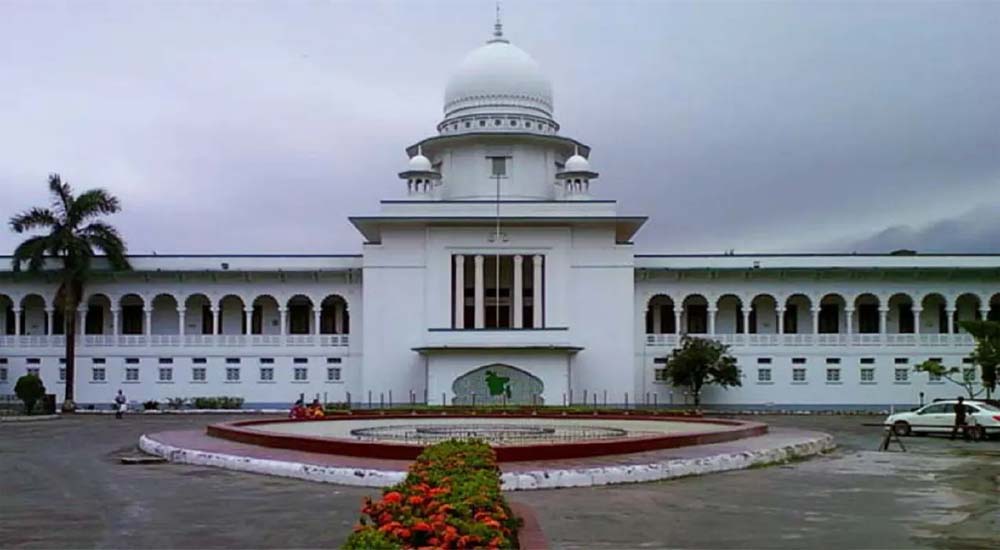
Muktadesh Desk: The fourth day of hearing on the appeal against the verdict to abolish the caretaker government has begun. The hearing began at around 10 am on Tuesday in a full appellate bench of 7 judges led by Chief Justice Dr. Syed Refaat Ahmed.
Barrister Ehsan A Siddiqui is hearing as an intervenor in the court. Advocate Mohammad Shishir Monir is hearing on behalf of Jamaat.
The appeal hearing to restore the caretaker government system during the election period began on October 21. Later, the second day of hearing of the appeal to restore the caretaker government system during the election period ended on October 22. Lawyer Dr. Sharif Bhuiyan concluded the hearing on behalf of the writ petitioner Badiul Alam Majumder on these two days.
Earlier, on August 27, the Appellate Division allowed the appeal against the verdict to abolish the caretaker government. The court said that it will hear the appeal again in this regard. In continuation of this, the hearing date of the case was fixed. Chief Justice Dr. The seven-member Appellate Division led by Syed Refat Ahmed gave the order.
Barrister Ruhul Quddus Kajal and Advocate Mohammad Shishir Monir heard the petition in court that day. Attorney General Md. Asaduzzaman heard for the state.
During the hearing, Chief Justice Dr. Syed Refat Ahmed said that the Appellate Division does not want to provide a temporary solution by returning the caretaker government. The Appellate Division wants an effective solution for the election-time government. So that it is not repeatedly disrupted. It will be done so that it has a far-reaching impact on establishing democracy in the country.
The Chief Justice also raised the question of when the caretaker government system will be effective if it is returned.
In response, the Attorney General said that in the past decade and a half, the people of the country have been exploited in various ways instead of being governed. People have been subjected to disappearances, murders, extrajudicial killings and political oppression. The systems that were in place to protect them from these have been destroyed and people have not received justice. Due to which the Awami League has fallen in this mass uprising. And it has been decided from that road who will be the Chief Justice and who will be the head of the government. There is no opportunity to disregard this power of the people in any way. Only by disregarding these things will a revolution be created. At this time, he also highlighted the context of the mass uprising of 90.
Later, the Appellate Division allowed an appeal against the verdict to abolish the caretaker government. In addition, October 21 was set for the appeal hearing on this issue again.
Incidentally, the Thirteenth Amendment to the Constitution was adopted in the National Parliament in 1996. Through this, the caretaker government system was included in the Constitution. However, challenging its legality, three lawyers including Advocate M. Salim Ullah filed a writ in the High Court in 1998. After the initial hearing, the High Court issued a rule. However, after the final hearing on August 4, 2004, the High Court dismissed the writ and declared the caretaker government system legal.
Later, an appeal was filed against that verdict in the Appellate Division of the Supreme Court in 2005. The court appointed 8 amicus curiae (friends of the court) in this case and heard their opinions. Five of them directly expressed their opinion in favor of the caretaker government system.
They are – Dr. Kamal Hossain, TH Khan, former Attorney General Mahmudul Islam, Barrister M. Amir-ul Islam and Barrister Rokonuddin Mahmud. Another amicus curiae, Barrister Ajmalul Hossain KC, expressed his opinion in favor of abolishing the caretaker government system. Barrister Rafiq-ul-Haq and Dr. M Zahir expressed their opinion in favor of radical reform of the caretaker government system and presented their proposal to the court. In addition, the then Attorney General Mahbubey Alam expressed his opinion in favor of maintaining the caretaker government.
Then, a full bench of seven judges of the Appellate Division declared the Thirteenth Amendment to the Constitution null and void on May 10, 2011, based on a majority opinion. In light of this, the Fifteenth Amendment was passed in the National Parliament on June 30, 2011, and the Gazette was published on July 3.
After that, three national elections were held under the Awami League. However, in the meantime, the government led by the currently banned party Awami League fell on August 5, 2024.
After the fall of the government, five prominent individuals, including Badiul Alam Majumdar, editor of Sushasn-e-Nagorik (Sujon), first filed a petition on August 27, 2024, seeking a review of the 2011 verdict of the Appellate Division to restore the caretaker government system. The rest were Tofail Ahmed, M. Hafizuddin Khan, Jobairul Haque Bhuiyan, and Zahra Rahman.
Later, BNP Secretary General Mirza Fakhrul Islam Alamgir filed a separate review petition on October 16 of the same year and Bangladesh Jamaat-e-Islami Secretary General Professor Mia Golam Parwar filed a review petition on October 23 of last year. In addition, freedom fighter Md. Mofazzal Hossain of Raninagar, Naogaon also filed a similar petition.
As a result, a total of four review petitions by political parties and individuals were heard by the full bench of the Appellate Division. After hearing those petitions, the Appellate Division allowed an appeal against the judgment to cancel the caretaker government on August 27. The court said it would hear the appeal again in this regard. In continuation of this, the case related to the caretaker government was again heard by the Appellate Division.