

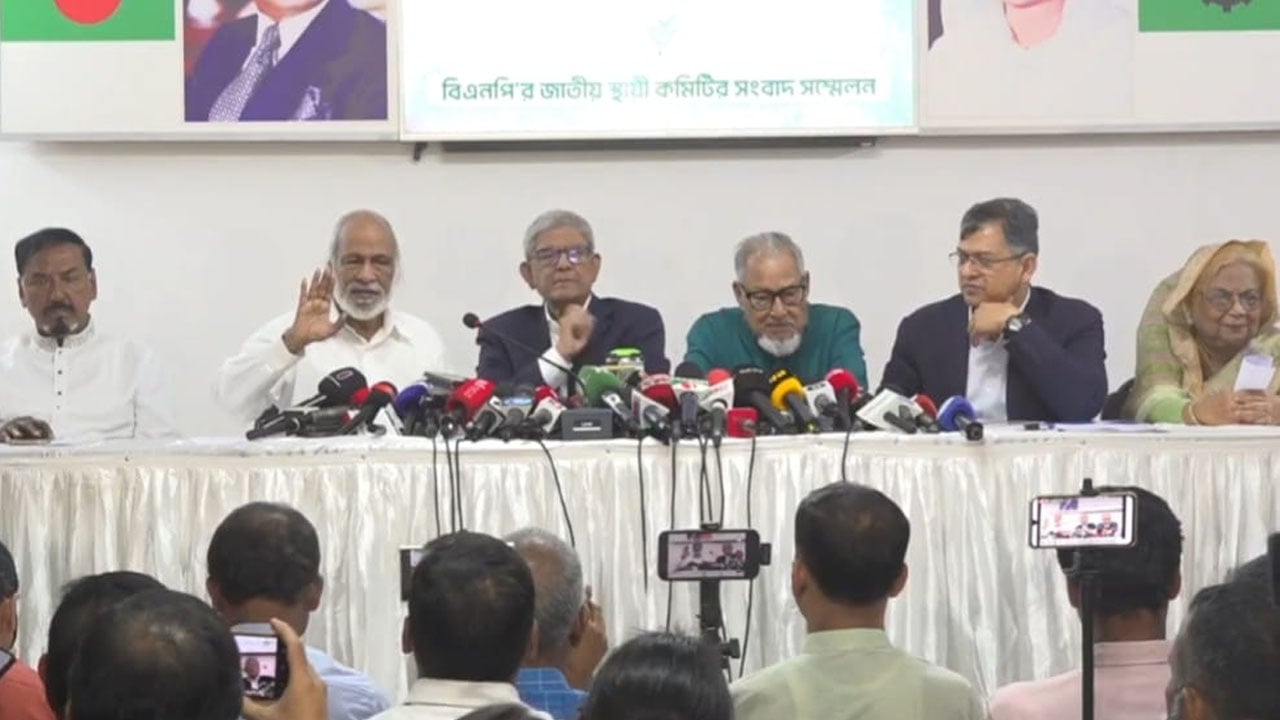
Muktadesh Desk: BNP Secretary General Mirza Fakhrul Islam Alamgir said that the government does not have the authority to issue a draft order to implement the July Charter. The proposal of the consensus commission has been imposed on the nation. He said that a referendum can be held on the day of the national election. The proposal to do it before is unreasonable and unnecessary. There is no such opportunity and time before such a big campaign as the parliamentary election.
Regarding the amendment of the constitution, he said that the July Charter proposal states that if the reform proposal is not implemented within 270 days, it will automatically be incorporated into the constitution. Such a proposal is undemocratic and ridiculous. He told reporters at the BNP Chairperson’s office in Gulshan in the capital on Thursday morning. Leaders of the BNP National Standing Committee were present at the time.
The BNP Secretary General said that in continuation of the long 16-year anti-fascist democratic struggle, a new democratic journey began in Bangladesh through the mass uprising of students, workers and the public in July-August 2024. The mass uprising created a historic opportunity to fulfill the democratic reform of the state system, the state structure, the expectations of the nation and the aspirations of the martyrs. Almost a year before the mass uprising, the BNP presented 31 points before the nation with the aim of democratic reform of the state structure in 2023. Mirza Fakhrul Islam Alamgir said that before that, it published 27 points in 2022 and Vision 2030 in 2017. Therefore, all political parties, social organizations, and private forces involved in the BNP and the anti-fascist democratic movement have been expressing their commitment to comprehensive reform and unity according to the expectations of the people. Therefore, genuine democratic reform of the state structure is one of the main political agendas of the BNP. We have welcomed the reform commissions formed by the current interim government after the mass uprising. We have provided detailed opinions on behalf of our party to the reform commissions on issues related to the constitution, judiciary, electoral system reform, administration, Anti-Corruption Commission, and police administration. Other political parties have provided their opinions. Later, we and other political parties held long discussions with the six reform commissions. Point-wise discussions were held on the reform proposals made by the six reform commissions. As a result of all those discussions, the National Consensus Commission was formed, whose president is the Honorable Chief Advisor.
He said, in the first meeting of the political parties with the National Consensus Commission, the Chief Advisor said that consensus should be established with the political parties on all issues. A national charter will be drafted and signed by including those issues. Later, the issues of that charter will be implemented in the elected National Parliament. He has clearly reiterated this statement in various speeches given to the nation. This statement has also been quoted in the July Declaration.
In the long series of discussions of the National Consensus Commission, consensus was reached on some issues with the dissenting opinions of some political parties. The way the July National Charter 2025 was drafted, this part of the Note of Dissent is clearly mentioned: If any political party or alliance that expresses dissent gets the mandate of the people by mentioning it in their manifesto, they can take action accordingly.
The BNP Secretary General said that the issues related to constitutional reform in the July Charter 2025 have been presented to the government in two alternative ways and to provide a legal basis. The letter states that in order to implement the issues related to constitutional amendments included in the July National Charter 2025, the government will issue an order called the July Charter Constitutional Reform Implementation Order 2025. The draft of such a proposed order is attached in Annexure 2 and Annexure 3. The government does not have the authority to issue such an order. As per the definition of Article 152 of the Constitution, an order has the status of a law. Therefore, the President has the authority to issue it. In Alternative Proposal 1, it is mentioned that the government will submit a full draft bill to the referendum for the implementation of the July Parliament. The reform proposals have been included in Schedule 1 of the bill.
He said, it has been said that the bill will be published in the official gazette. The bill mentions that there will be a referendum on the 48 clauses proposed by the National Consensus Commission as mentioned in the Schedule Act related to the Constitution. The opinions, dissents, and notes of dissent of the political parties included in the July National Charter signed against these clauses have not been mentioned. That is, an attempt has been made to impose the proposals and recommendations of the Consensus Commission unilaterally and forcibly on the nation. Then it appears that the long-term discussions of the political parties with the Reform Commission, the National Consensus Commission, for a long time, were meaningless, a waste of money and time, farcical, and a betrayal of the nation.
The BNP Secretary General said, in a democracy, political parties will have differences of opinion, it is natural. That is why the need for dialogue arose. But the Consensus Commission did not take into account the democratic rights of political parties to express their differences of opinion. The said implementation order states that, along with the formation of the National Parliament consisting of the representatives elected in the general election of the National Parliament, a Constitution Reform Council will be formed at the same time. They will take oath separately as members of the Parliament and members of the Constitution Reform Council. That is, the elected National Parliament will be called the Constitution Reform Council at the same time. The question is, can the Election Commission constitutionally establish the National Parliament and the Constitution Reform Council?
Send feedback
Side panels
History
Saved